When desire inhabits art
di Gianluca Ranzi
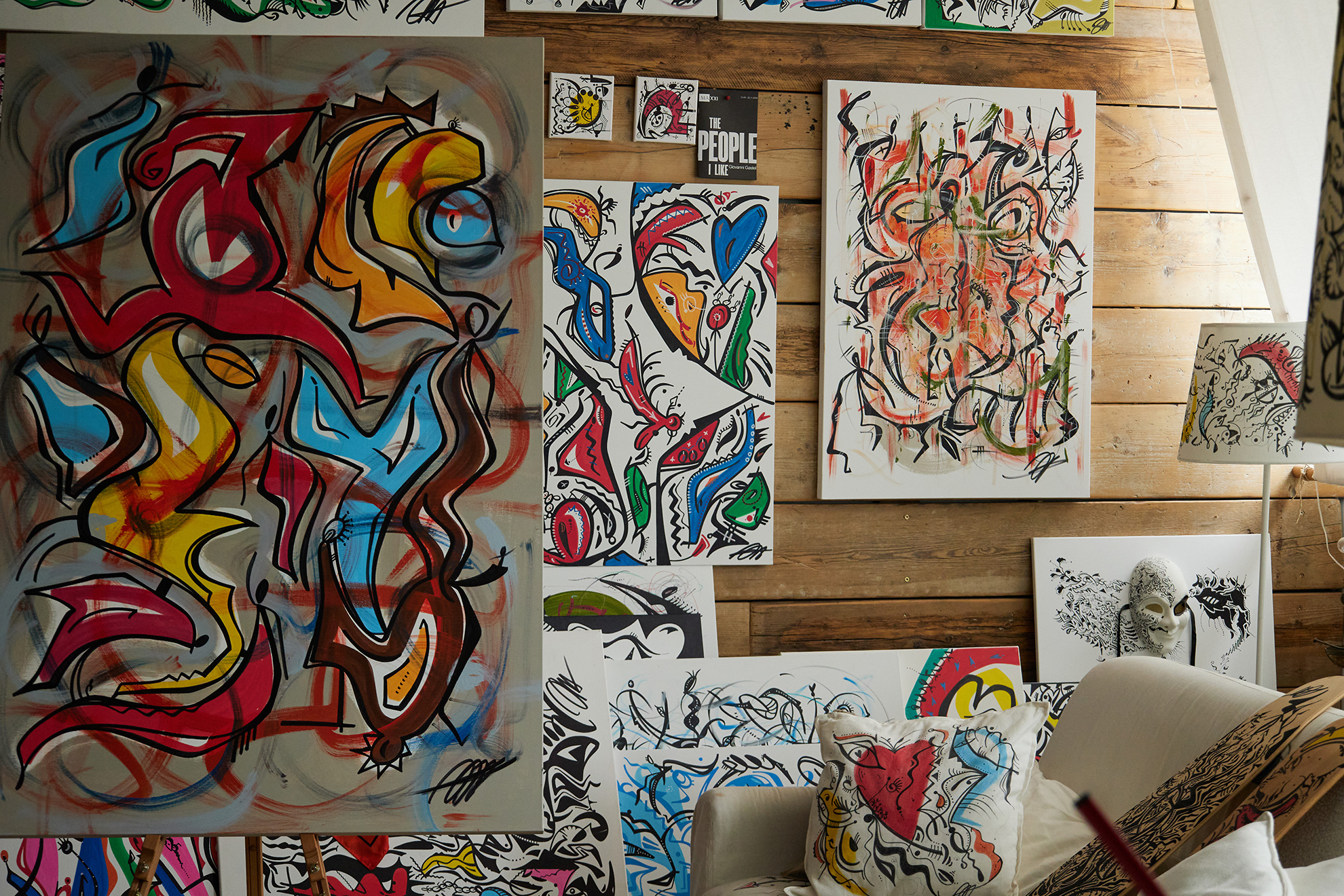
The desire for art that inhabits Benito Macerata’s painting takes him on a trip inside and outside himself, as his own work isn’t just focused on himself, but is also an opportunity to place him in relation to the world. Benito Macerata is thus a bridging artist: his grids of signs, the arabesque graphemes, the bright colours, the black line that sprouts into figures and ornamentation, they are all opportunities for passage and discovery, they are paths that the eye travels seamlessly, they are words in image, sometimes musical scores, a dance of the brush and the marker, the tools for letting the other enter his magical territory.
In Benito Macerata’s works one feels the presence of a joyful mystery, especially when the space opens to infinity. The viewer thus grasps a world teeming with archaic and suggestive presences that move in every direction, thickets and geographies of rapid and incisive signs that let one glimpse fairy-tale animals, giant eyes and mouths between the angelic and the spirited, and then tiny figures, musicians and dancers.
Benito Macerata’s painting immediately resonates with the viewer, captivating him with the same enthralling crescendos as George Gershwin’s Rhapsody in Blue. It is evident in those works which spontaneously reverberate their joyful, instinctive and immediate charge on the viewer, the opulence of colour combined with the sinuosity of drawing. Yet there is also a calibrated control of composition and a skilful use of references, from Street Art to high culture and art history. From Fernand Léger’s shapes, to the graphic imagination of André Masson, from the Indian primitivism of the early Pollock, to the gestural elegance of Mark Tobey, to the graffiti art of Rammelzee, A-One and Daze.
It all flows into a world of fluid and wandering forms, enigmatic gazes of idols between the benevolent and the curious, totemic figures, spirits and little hearts, traces of constellations and unknown animals, chasms and skirmishes, wind-blown figures and traces of lost alphabets.
This dynamic result, which synthesizes the speed of hand and the rigor of thought, is also achieved through the incisiveness of the black outline, which emphasizes the two-dimensionality of the figures and allows the forces within the composition to weld themselves into one simultaneous, interpenetrating totality. These works are ultimately dwellings, harbouring worlds where biology and art, music and writing, mysticism and spirit, nature and culture dance together-in a word, life!
Canvases, papers processed and superimposed with a technical procedure that incorporates filaments and cords, everyday objects and textiles, thus become containers of gushing and restless microcosms, quick to catch the jolts, syncopated rhythms, the feverish states and thickenings of a phantasmagorical universe.
The space of Macerata’s painting is sometimes two-dimensional, while at other times it opens ubiquitously, transversely and profoundly. The pluricentric space of the canvas stages a world whose cells, subject to incessant and multidirectional movement, are engaged in a sinuous dance of forms, signs and vibrant nature.
Here it becomes possible to think of our identity as something multiple, perpetually subject to change, of life as an opportunity for confrontation, deep joy, cosmic love, contamination and relationship.
Beyond the strictures of reason, Benito Macerata thus knows how to stage impulses and desires. The artist’s work, regardless of the medium used, occupying the space of life, depicts open and dancing forms, fused with the world, the prototypes of a more authentic future. It is the future that desire needs in order to find its realization in the present of the work. This happens each time the white sheet of paper calls out to the artist with the enchanted voice of a siren, welcoming that first stroke of black marker.
Gianluca Ranzi